
Draft 1
In this project, I chose Silvio Lorusso’s poster work We Are Human Beings. This poster uses machine generated distorted fonts to write a manifesto of resistance against technological violence. In Silvio Lorusso’s view, CAPTCHAs, as a dehumanizing force, are a means of control applied to ‘technocratic bureaucracy’. CAPTCHAs are both the gateway to accessing websites and the way machines verify and judge us. Regarding this, I have combined two theoretical perspectives: Rouvroy and Berns (2013, pp. 163-196) point out that ‘Algorithmic Governmentality’ turns technological tools into an invisible management mechanism. Furthermore, according to Marx’s (1959) theory of ‘Alienation’, a relationship of estrangement and opposition arises between the producer and the objects they create. I use this to focus on the phenomenon of ‘power inversion’ in the digital age.
The research point I propose is: In a situation where machines judge human authenticity, how can graphic design respond to this alienated ‘Algorithmic Governmentality’?
I hope to use this as a starting point for studio design practice to explore those moments filled with tension and differentiation between humans and machines in the era of computer algorithms.
References:
Marx, K. (1959). Economic and Philosophic Manuscripts of 1844. Translated by M. Milligan. Moscow: Progress Publishers. (Original work written 1844).
Rouvroy, A. and Berns, T. (2013). ‘Algorithmic governmentality and prospects of emancipation’, Réseaux, 177(1), pp. 163-196.
Draft 2
In the past three weeks of continuous experimentation, I have learned Python to build a website for text distortion as my tool for iteration. Through this, I aim to touch upon an increasingly absurd reality: under the rule of computer code, we are living in an era where we must prove to machines that we are ‘human.’
My project began with the copying and deconstruction of Silvio Lorusso’s poster work, ‘We Are Human Beings!’. Lorusso uses the visual style of CAPTCHAs to distort text, placing Mario Savio’s 1964 ‘Free Speech Movement’ manifesto within the poster to criticize the inversion of power in today’s digital age (Savio, 1964).
In the past, protesters resisted the exploitation of humans by computers by damaging early storage devices (punch cards), making the letter shapes unrecognizable to the machines. Today, however, we are forced to accept machine generated distorted characters, performing this digital labor just to gain the right to use a computer.
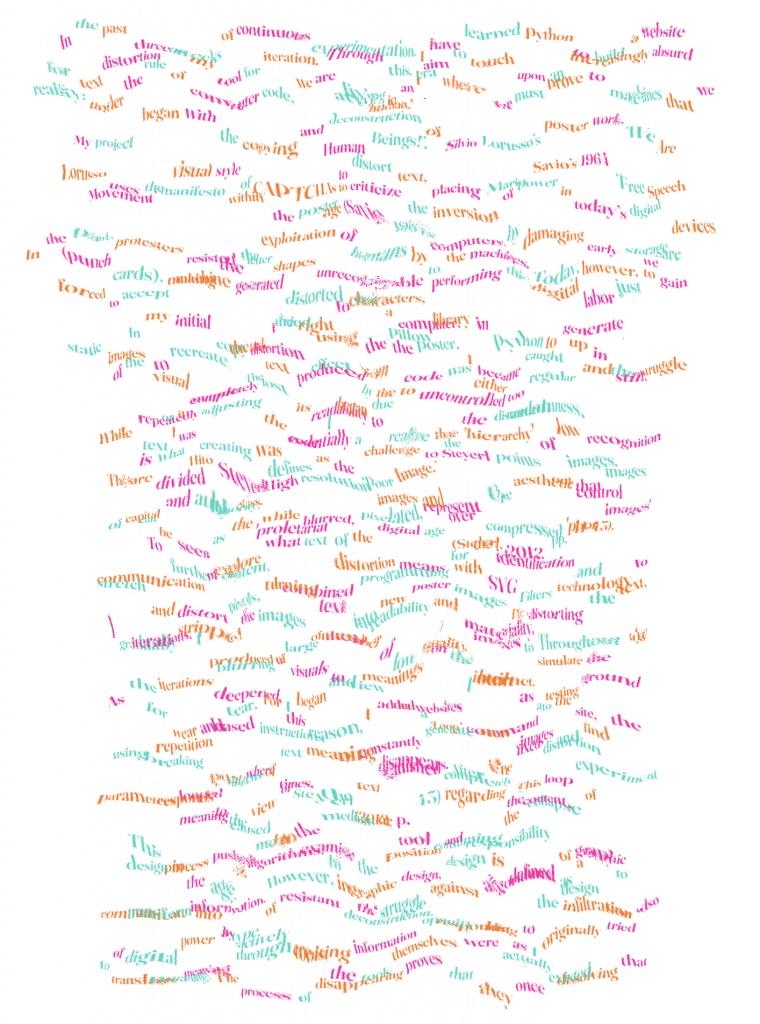
In my initial copy task, I tried using the Pillow library in Python to generate static images to recreate the distortion effect from the poster. I became caught up in the struggle of the visual output. The text produced by the code was either too regular and stiff, or it completely lost its readability due to uncontrolled randomness.
While repeatedly adjusting the code, I began to realize that the distorted, low recognition text I was creating was essentially a challenge to the ‘hierarchy’ of images. This is what Hito Steyerl defines as the ‘Poor Image.’ Steyerl points out that images are divided by class. High resolution images represent the aesthetic control of capital and authority, while blurred, pixelated, and over compressed ‘poor images’ can be seen as the ‘proletariat’ of the digital age (Steyerl, 2012, pp. 41-43).
To further explore what text distortion means for the identification and communication of content, I combined programming with SVG Filters technology to stretch and distort pixels, turning text into new poster images. By distorting the text, I gradually stripped the images of their readability and materiality. Throughout the iterations, I produced a large number of low quality images to simulate the blurring of visuals and meanings on the internet.
As the iterations deepened, I began to view the websites I built as a testing ground for wear and tear. For this reason, I added a ‘Loop’ command to the site, using repetition based instructions to constantly generate new images and find the breaking point where text meaning disappears. After the fixed distortion parameters looped dozens of times, the text vanished completely. This loop experiment responds to the view of Steyerl (2012, p. 43) regarding the collapse of meaning caused by the medium or tool consuming the content.
This process pushed me to examine the position and responsibility of graphic design in the age of algorithms. In graphic design, design is defined as a way to communicate information. However, in the struggle against algorithms, design can also transform into a type of resistant deconstruction, responding to the infiltration of digital power by actively creating information opacity. Just as I originally tried to translate meaning through tools, the tools themselves were actually dissolving that meaning. The process of disappearing proves that they once existed.
References:
Savio, M. (1964) Sproul Hall steps speech. [Speech] University of California, Berkeley, 2 December. Available at: https://fsm.berkeley.edu/mario-savios-speech-at-sproul-hall-steps/ (Accessed: 11 February 2026).
Steyerl, H. (2012) ‘In defense of the poor image’, in The wretched of the screen. Berlin: Sternberg Press, pp. 31–45.
Draft 3
Leave a Reply